Sunday, October 24, 2010

Incorporating Craft and Technology at MIT


In this week's CRAFT Video, come with me to the Media Lab at the Massachusetts Institute of Technology. There I met with e-textiles pioneer Leah Buechley and students from her research group called "High-Low Tech," which Leah describes as "blends" of technology with traditional crafts to make new toolkits for creativity and learning. I had so much fun checking out the amazingly brilliant and fun projects by Hannah Perner-Wilson, Emily Lovell, David Mellis, and Bonifaz Kaufmann, I had a hard time leaving!

Wednesday, September 1, 2010

Updated Class Schedule

VI. Schedule of Classes

Week 1 and 2

1.Overview of course
2.Use of ”Computer is Just a Tool to Make ART! “
3.Overview of Open Source Programs
4.Use of “Youtube” and Google as a Help tool
5.Photoshop and Basics. Setting up workspace and Tool bars.
6.Ctrl Z, Undo button, and use of history window.
7.Preview of Digital Artists
8.Creating digital images with traditional art techniques.
9.Digital Photography of Artwork. (It is much easier to work with a great original instead of trying to fix the original image on the computer.)
10.Photoshop basics. Workspace, Tools etc.

Exercise: View Class Blog and Select favorite Artist.
Exercise: Create art images to be photographed.
Exercise: Read Kenneth Huff interview for Monday class discussion
Week 3.
1.Photoshop techniques: Advanced Use of masks, layers, and filters.
2.Inkscape basics
3.Vector exercises. From hand drawn to Vector
4.Exercise: Transfer image from printed to traditional art.
5.Hand Gesture Drawing over Digital Printout.
6.Digitally Combine Hand Gesture Drawing with Digital Printout.
7.Scanning artwork
8.Exercise: Do research on digitally based artists at Artprize.

Exercise: Create collage with Photoshop using images from last weeks exercise
Week 4
1.Discuss traditional artists work and how it relates to Digitally Based Art
2.Photoshop Advanced techniques: Creating Patterns, Brushes
3.Inkscape Advanced techniques: Creating Patterns,
4.Learn the basics of Google Sketchup 3 D Modeling
5.Output: Transfers form Ink Jet Prints to paper and beyond.
6.Exercise: Discuss your favorite digitally based artists from Artprize.
7.Exercise: Find a traditionally based artist that could have used a computer as a tool; to make art.


Week 5 & 6.
1.Sketchup 3 D Advanced techniques
2.Exercise: Create a 3D object/ sculpture in Sketchup
3.Photoshop Advanced techniques: 3D imaging, warping,
4.Review of which “Digital Based Artists” will be presented by students.
5.Exercise: Do tutorial posted on class Blog.
6.Exercise: Do Discuss your favorite digitally based artists from Artprize
Week 7.
1.Review of Photoshop and Inkscape techniques
2. Exercise: Do tutorial posted on class Blog.
Week 8.
1.Midterm review and Critic of Art and technique.
2.Advance Digital Techniques
3.Work on Digital creations.
4.Experiment with output techniques.
5.Exercise: Do tutorial posted on class Blog.
Week 9.
1. Work on Digital creations
2.Exercise: Do tutorial posted on class Blog.
3.Exploring Output:
a)Laser Cuts, paper, wood
b)Plotter cut Sandblast material as a woodblock plate.
c)Plotter Cut Vinyl as a stencil for painting.
d)Ink jet Decals to transfer to a 3D object.
e)Water-jet cutters for sculptural use.
f)Large scale images, Billboards, Vinyl wraps.
Week 10.
1.Over view of Programming Art and Fractals
2.Combining 2D artwork into Motion.
3.Exercise: Do tutorial posted on class Blog.
Week 11.
1.Work on Digital creations.
2.Studio time to create art.
3.Exercise: Do tutorial posted on class Blog.
Week 12.

1.Work on Digital creations.
2.Studio time to create art.
3.Review and Critic of Art and technique.
Week 13.
1.Digital Presentation of Digital Based Artists
2.Finalize Sketchup designs to ready for output.
3.Work on Digital creations.
4.Studio time to create art.
Week 14.
1.Create a 2D or 3D prototype art presentation, for a large-scale commission.
2.Work on Digital creations.
3.Studio time to create art.
Week 15.
1.Present 2D or 3D prototype art presentation to class.
Explain techniques used.
2.Finalize work on Digital Creations and Studio Artwork.
3.Create a simple animation from 2 D Digital images.
4.Create a Prezi Collage of your digital artwork

Week 16.
1.Finalize work on Digital Creations and Studio Artwork.
2.Present animation in a creative way.

Final Review and critic of finished artwork

Kenneth Huff Interview


Kenneth Huff, is an artist I met on the streets while I was selling my artwork at art fairs. He was one of the first digital artists to show his work.


from the interview:


Having exhibited his artwork in more than 350 shows internationally, Kenneth Huff is one of the world's most renowned digital creatives--redefining the word fabulous. With an amassed portfolio of naturalistic permutations in prints, sculptures and time-based works, Huff explores organic forms found in the natural world--the ever present beauty in everyday surroundings. Of his sumptuous signature style, he says "Organic structures harkens back to the main point of my work--patterns in nature. Why I create is not about the technology, it's about the image."

Thursday, August 26, 2010

Digital Desserts


Here is my latest Digital Dessert!

Wednesday, August 25, 2010

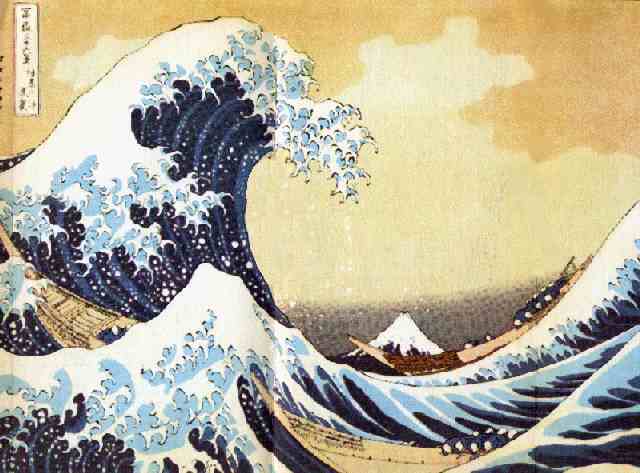
Katsushika Hokusai


Hokusai (1760-1849)

Katsushika Hokusai, Japan's best known artist, is ironically Japan's least Japanese artist. Japan's best known woodblock print, The Great Wave, is very un-Japanese. Welcome to the artist often known as Hokusai.

Hokusai (1760-1849) lived during the Tokugawa period (1600 to 1867). In a Japan of traditional Confucian values and feudal regimentation, Hokusai was a thoroughly Bohemian artist: cocky, quarrelsome, restless, aggressive, and sensational. He fought with his teachers and was often thrown out of art schools. As a stubborn artistic genius, he was single-mindedly obsessed with art. Hokusai left over 30,000 works, including silk paintings, woodblock prints, picture books, manga, travel illustrations, erotic illustrations, paintings, and sketches. Some of his paintings were public spectacles which measured over 200 sq. meters (2,000 sq. feet.) He didn't care much for being sensible or social respect; he signed one of his last works as "The Art-Crazy Old Man". In his 89 years, Hokusai changed his name some thirty times (Hokusai wasn't his real name) and lived in at least ninety homes. We laugh and recognize him as an artist, but wait, that's because we see him as a Western artist, long before the West arrived in Japan.

"From the age of six I had a mania for drawing the shapes of things. When I was fifty I had published a universe of designs. but all I have done before the the age of seventy is not worth bothering with. At seventy five I'll have learned something of the pattern of nature, of animals, of plants, of trees, birds, fish and insects. When I am eighty you will see real progress. At ninety I shall have cut my way deeply into the mystery of life itself. At a hundred I shall be a marvelous artist. At a hundred and ten everything I create; a dot, a line, will jump to life as never before. To all of you who are going to live as long as I do, I promise to keep my word. I am writing this in my old age. I used to call myself Hokosai, but today I sign my self 'The Old Man Mad About Drawing." -- Hokusai

Hokusai started out as a art student of woodblocks and paintings. During the 600-year Shogun period, Japan had sealed itself off from the rest of the world. Contact with Western culture was forbidden. Nevertheless, Hokusai discovered and studied the European copper-plate engravings that were being smuggled into the country. Here he learned about shading, coloring, realism, and landscape perspective. He introduced all of these elements into woodblock and ukiyo-e art and thus revolutionized and invigorated Japanese art.

Although Chinese and Japanese paintings had been using long distance landscape views for 1,500 years, this style had never entered the woodblock print. Ukiyo-e woodblocks were produced for bourgeoisie city gentry who wanted images of street life, sumo wrestlers, and geishas. The countryside and peasants were ignored.

What was the influence on Hokusai? Here's an example of Dutch landscape art:

Sunday, May 9, 2010

Erik Johansson's Digital Photographs WEBSITE


I'm a 25 years old photographer from Gothenburg, Sweden. Working mostly with personal projects and commercial work. I see myslelf as a photographer as much as a retoucher, a combination that is only limited by my own imagination. I hope you find my work inspiring!

Here is a link to a youtube video:
http://www.youtube.com/watch?v=DKaTDHUTYPU&feature=related